Saturday, April 17, 2010

Tiny Dancer

In Jericho on Wednesday, before the evening program, a little girl in a white dress came through the doors. She stood, quietly, at the threshold. She was perhaps 3 or 4 with wide eyes, midnight blue-brown hair and caramel skin; a beautiful child. Shy. 

Or so she seemed. 

To her left was the stairway to the stage and the 20 foot wide mural of Hisham’s Palace, a ruin and relic of a bygone era of dominance and majesty. The stairs, and then the stage, caught her eye in that singular way, that love at first sight way, that tells you about a passion that is wordless and even were there language for it, it would be inadequate irrespective of the skill of the speaker. Moth to the flame, bee to the honey she made for it.

Small feet in small shoes, to the sounds of American folk-pop-soul singer Amos Lee, she found the light and then simply started dancing. There was a pattern in it, a way about it, that said she’d been watching someone somewhere who knew dubka, the folk dancing of the Palestinians and the Arabs in the region. The arms angled and the knees bent and the feet tapped, and if there had been traditional music it would have been a culture-specific moment. But the sounds were utterly American, and the dress baby-white and as easily fit into Jersey as Jericho.

That moment, at that stage in her life, was a road to anywhere moment. All cultures, all paths, lie open to her in this instant. She is not Arab, not Palestinian, not American or Chilean. She’s just a child who hears a sound and the sound is a calling and the stage is the place to which she is drawn to answer that calling.

It’s a safe bet that Amos Lee was never heard on that stage, in that theater, before that moment. Yet his rhythms, his soul, both as a genre and a life, spoke to her regardless of spoken language. She danced as she knew as he sang as he knew. English and Arabic were irrelevant. Culture as defines us and demands of us a way of doing and a way of being, was lost in the freedom of being atop a marly floor in the early evening hours of an April dusk.

Watching this from a few feet away I lost track of the conversation I was in, a brief dialogue with our hosts, the American Consulate General, Jerusalem, the office within the Department of State that is responsible for US-Palestinian relations. My camera was 20 feet away and it, too, was calling.

Some people sense the camera. Most shy from it. A few indulge it and a far smaller number still are turned on by it. She was in the latter category. That lens was for her the audience she sought. Where moments earlier she was dancing in and for herself, the shutter click of my camera was transformative. In the best traditions of a super-model she moved to and for the lens. It was utterly organic for her.

Some days, weeks and years from now I will wonder about this little girl from a 10,000 year old city. Will she find herself along that incredibly difficult path towards becoming a practicing artist as she is a natural one? Will the tools, techniques and possibilities open for her as they have for others in my world? How much harder will that path be for her than it has been for Kathryn or Giselle? Will there be a path and what are our possibilities for helping to foster it? This is, ostensibly, why we are here at all – to set a road which leads to artistic opportunity for young dancers and artists who can follow a passion born into them at a genetic level.

I wonder for her, and for the ones like her who bounce off our world too easily and too briefly. What does the future hold, and what is our responsibility to it? When you come to a place and introduce an art, when even for a few that art is a light bulb, how do you keep the current flowing? And if you can’t, have you done better by them or worse by them for simply juicing it up for just long enough to see the contents of the cave, the colors and contrasts, the illuminations of possibilities. It’s a question which follows me around throughout my time away from the options of our schools in DC, where there is actually an opportunity to do something when you see that child in that moment.

The odds are that the little girl in white has crossed my path, and my lens, for the only time in our lives. But she’s burned into my mental lens as surely as into my camera lens, and its not clear to me what that will lead to.

Just after noon, Saturday April 17th, I wonder if she’s at home, dancing.

Jericho

Picture a city that is preparing to celebrate its 10,000 anniversary. At home we look at things which are 100 years old and think about them as antiques. We go shopping in Pennsylvania, wandering Amish country, for that 75 year old bargain that no one else has noticed -- and its a steal! Now take it back about a zillion times further. And its not like there's a rock somewhere in whatever the ancient precursor was to aramaic that says "Jericho founded on this day." Of course, no one had invented writing 10,000 years ago anyway, so the chances of that were kind of small. Imagine a city that traces itself back before writing. 

Crazy. 

Then picture a bunch of Americans dressed up in skin tight costumes doing Jungle Books in front of a gathering of kids who, in the words of one of our program sponsors "have never seen anything like this in their lives" (I didn't really want to say that sometimes we feel like that at home, too).

Then jump over to the Dead Sea, where the next round of contrasts will set your mind wandering. Women in full burkas immersing themselves in the salt and mineral filled water next to bikini clad CityDancers. Men walking along covered in the "healing muds" with cigarettes in their mouths. 

Thursday, April 1, 2010

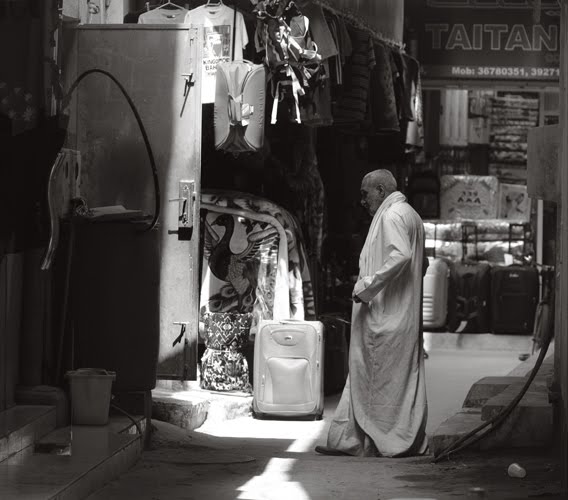
The Souq in Black and White

One of the things I miss most in photography in the digital age is black and white imagery. As rich and elegant as color is, there is an absence of texture in it sometimes, a certain depth that reveals itself only in black and white. In Manama, as in so much of the Middle East, black and white are colors of life in a way they are not in the West. While we dress for color, they dress for contrast -- the women in black, the men in white. In that sense it really is a black and white world, and all in between is gray.

While working through several images from the Souq in Manama I found myself drawn to a now almost lost way of working, and so went back to black. Here are a few of the results.


Wednesday, March 31, 2010

Fade to Black

Mohammed is 51. He was born along the sea on the West Coast of Bahrain in 1959. His father was a mason, and when he was young he lived in an old house with no electricity, no running water nor proper plumbing. At night in the summer his entire family would sleep in the central courtyard of their mud brick and wood home on an elevated platform to keep them from the land-crawling bugs. He tells me this in the pre-dawn hours driving his car through the neon, fluorescent and incandescent glow of ever lit Manama. He would play in the sea as a child, immersed in the waters and traditions of his culture and country.

45 or so years later he glides his vehicle into secure area of the Manama Airport and guides us through emigration. I ask him if that kind of transformation has been hard -- say on his father. He says it was unimportant to his father, and that what mattered was his ability to provide. He's still living.

On the way from lunch on Tuesday after an extraordinary conversation, one of our hosts was musing on the challenges of keeping her children on track and focused. They're 11 and 13 -- Aidan and Nathan's ages. She notes that they're very bright children and that they should be getting top grades. When her daughter comes in with a "C" she takes away her mobile. When it happens again, she maintains the prohibition. "Kids just want to be texting and on their phones all the time." Denial of technology is ubiquitous as a punishment now. I hear the same penalties in Washington, in Amman, in Santiago. Its all driven by oil.

In 15 years time Bahrain will have no more oil. "My husband and I teach our children to respect work and live modestly. So many children now here change their mobiles every month." She pauses when we talk about the oil running out, about the possibility that all this affluence, the building, the wealth, the mad consumption and the Rolls Royce barrage coming to an abrupt end. "No on knows what will happen. We have to prepare our children." She sounds like someone aware that the future is no more clear for her than it was for Mohammed's father, who could not, from the steps of his home, the sounds of the sea and the splashes of his Son echoing in his ears, predict that in one lifetime everything would change. We are in a jet-stream of change, a whirlwind of it. The world here is upended from a generation ago. It may be again a generation from now.

The sun is somewhere waking as the flight from Manama leaves the earth for the sky. The sky lightens as the land recedes. Bahrain slipping into the distance.

Fade to black.

Tuesday, March 30, 2010

Nature Boy and the snake


Along the main drag in Manama, opposite the Culture Hall and the National Museum.

These are all over Manama, posted along the strips that divide the traffic. Running across them was something of the "run for your life" experience a bit akin to jaywalking on the beltway. But how could we pass it up....

For the Photoshop freaks out there, note that Jason is suddenly wearing a shirt in these with a cowl. It's actually Jerome's copied over from the figure to Jason's left. We didn't even notice it until we were standing right under it.

I'm guessing that the designers were concerned about having a dozen bare-chested Jason's all over Manama and that it would create a situation that didn't need to be there.

Personally I think its fine and worth the ribbing we can give Jason about wearing a tunic.....

And then there's Alice, twenty feet high in the air and 60 feet across. Not a bad perk for having to wear that costume, you know?

Monday, March 29, 2010

Sandstorms (Part 2)

“Stay in the car,” I said to the passengers in the back seat.

Pulling up to the Book Fair in Manama in our dusty white Crown Victoria I had the first “alarm bell” moment of my combined six weeks in the Middle East in the last 48, and that included time in South Lebanon. In the back seat were Daniel dressed in full as a Jungle Books monkey and Kaitlin in a skin-tight and distractingly sexy snake-skin unitard as Kaa. Out my window was a sea of white and black. Of all the places we had traveled, whether through CityDance or through the Iraqi Voices Amplification Project, from Ramallah to Damascus, Jerusalem to Amman, this was by far the most conservatively dressed I had ever seen a gathering. Women in full black abaya and niqab, faces covered at least to the eyes and often completely veiled and hands gloved. Men in dress white. Most children – and there were an endless stream of them – were clothed as formally as I had seen them as well.

I had images of a culture clash of a manner I really didn’t want to step out of the car and into.

We had been invited to come to the Bahrain Book Fair by one of our hosts to celebrate our performances of Rudyard Kipling’s Jungle Books, the why of our coming to Bahrain. In the theater the night before a crowd of 700 had fallen in love with all our characters, and the 400 turned away testified to the popularity of the concert and the characters. But here we were, on the equivalent of Sunday, walking into a Book Fair not simply dressed as cartoon characters (American cartoon characters for that matter) but I had made a decision to bring the one figure in all the show who was an absolute, straight ahead sex symbol of a snake. The night before this made a ton of sense to me because she’s invariably the most popular figure in the show after Mowgli, filled with mystery and menace and able to knock out an entire pack of monkeys with a glance. But in the bright light of day and the considerable separation between theater and street that decision seemed in the moment to rank right up there with the dumbest I had ever made.

Add to this the fact that we were really, really late. I went looking for someone who would be there to meet us, because I wasn’t about to get out of the car in my 19th century, borrowed from the Opera costume and glued on maxi-mustache and lead my band aimlessly into street and the Hall, asking “anyone know where we’re supposed to be?”

That person was not five feet from the car and as reassuring as possible – which did nothing to take my blood pressure down.

My reaction had created a similar spike in Kaitlin and Daniel’s own blood pressure, and as we walked the probably 100 yards from the car to the entrance of the Hall I kept thinking to myself “this is a hell of a way to start an international incident.” Normally you want every eye in range to be looking straight at you – it’s the point behind performance. But in this moment I really wanted to just cover Kaitlin in a tarp. She, of course, was the picture of elegance. She stood up taller, walked in perfect snake-character and owned the character--- this as the center of an unending series of glances (again, that was the point).

I glued our guide to her side, thinking that at least if someone walked up to us and asked, flat out, who the Hell we thought we were to be walking around that way he’d be able to say we were invited.

At the front of my thinking were the endless admonitions, and requests for cultural sensitivity, we had been given before coming over. Modern dance, with all its contact and, often, sexuality, is about as close as you can get to whacking the sensitivities of conservative cultures, who place a premium on female modesty, upside the head. A few years back a company from Lebanon had created an enormous scandal with their dance program – one that led to trouble for the entire Spring of Culture Festival. When we had first started discussing coming to Bahrain much of the conversation had been about appropriate programming, and how a modern repertory program was definitely not going to fly. Jungle Books, because of its story line, seemed safe and right – and the interest in the program was bearing that out. It didn’t matter that they were wearing skin-tight costumes, they were doing so in service of beloved characters from a timeless story well known it seems in every corner of the world.

And here I was walking down the sidewalk with a skin-tight snake……

To be continued

East meets West

Monday, March 29, 2010.
Muharraq, Bahrain. About 1:30.


Contrasts


Manama, like so many cities in the Gulf, and around the world, is exploding outward. Not so much reinventing, but INventing itself building by building, island-by-island, terraforming what had been an endless natural landscape into one imagined utterly by man. Its jarring in the extreme. The traditional city -- the old city -- is tiny, set on a small island at the very North East of the country (which, at less size than Hong Kong isn't really giving you that much to go on). Muharraq, the name for that city/that area, is also so very small. Yet it is infused with magic that only time gives breath to -- time to settle in, time to age, time to inhale and not be afraid of the space between the breath you draw in and the one you draw out.

On Monday the company as a whole (15 of us) boarded our bus and made the 15 minute journey over the causeway to take it in for that fleeting tourist eye view. Even in a moment the contrasts between old and new were stunning. En route from the hotel you flash forward, caught in the vortex of a development boom that leaves everything half built and chaotic - a "senses-sore."


Yet you also know that seeing anything half-done leaves you disoriented. Then you zoom past something wondrous architecturally, a vision of 21st century genius.


A moment later you are lost in the winds of time, blown to quiet, grace, beauty and a remembrance you never had in a place you never imagined, of a slower age and a more graceful era.


In that moment you are captivated, shocked, delighted, left wondrous and yet saddened, because lurking is the question that we all confront -- why would we choose to lose our elegance and breath in the interest of replicating the madness any building boom casts down on us, of the accelerated pace we are hopped up on at home even as we claim to want something more human. In the old streets of Muharraq that humanity is at play as though there were 20 generations holding back the tide in the straights of steel and cement, tar and technology.

Sandstorms (Part 1)

The sun gets up early here, streaming through the hotel window only a bit after five am. Not so long after the last drumbeats rumbling through the concrete and rebar superstructure of the hotel fade from the nightclub four floors down. There is something about the way sound travels in this part of the world. It reminds me, paradoxically, of the thumpers used to call Shai Hulud, the fabled sandworms of Frank Herbert’s “Dune” series. Things rumble, the deep rumble of the IRT approaching the station at 14th. Shaking the souls of the feet before coming to the eye.

The sky revealed itself in the varnished cerulean blue (think Maxfield Parish skies and you’re close) we’ve come to know along the lip of the Persian Gulf. Out the window, looking along the main drag, there was still traffic, but diminished as you would anticipate for the last day of the weekend at the earliest of hours, which here is on Saturday, not Sunday. As at home the paradox is that when there is less there is more – more speed. Cars fly by and the ubiquitous insect-buzz of an amped up motorcycle penetrates the glass, the walls and the skull no matter how deeply asleep you may like to think you are.

Young men like to spin out their cars in exactly the same fashion as they do at home, and with the same sly grin visible behind the safety glass of the windshield; the power of the lead foot and the dexterous arm. The March air is light, ephemeral, offering less resistance to the quick steps of a dancer.

Yet come mid-morning it all changes. There is a bit of rain; large slow

-falling droplets coming seemingly from the open sky. It’s startling. Rain? Here? It’s just a stereotype. At least I think it is. Then it’s gone, big splatters on the sand-stained windshield like the child’s bucket on the beach in a South Jersey Summer.

{In the evening before the dawn there was a fire.

In the hotel.

In the washing machine/dryer unit in Christopher/Jason/Maleek/Daniel’s apartment.

The real deal. Big flames shooting out of the machine and scorching the cabinetry. Fire-extinguisher type fire. That’s one way to keep people from doing laundry. The water in the drum kept the clothes from the flame, but offered little help to the half-washed wear. }

By 10:30 the blue above is gone, replaced by a thick haze of sand that mimics the densest smog of LA, blotting buildings from view, foreshortening the sky, setting off the rich textures of the Gulf in an obliterated horizon that lends itself to fable and mystery. You imagine a dhow, a native ship now seemingly almost of legend, appearing through that veil laden with – what? Where does your imagination take you? To trade? To warfare and raiding parties? To a Bahrain in the first millennium or back in the recesses of civilization? To life in another age? Your frame of reference is smog and urban pollution, but it’s an obscuring of another kind — from nature, a sandstorm filling the sky from some storm west, in Saudi Arabia. Michael Ondantjee can’t be far away with a name for the filling of the air. His descriptions of the great storms of North Africa, the named winds, comes to mind. “The Aajej, against which the Fellahin defend themselves with knives. The gibli.” The throat and the eyes detect the sand before the mind does, a slight scratch that comes almost subliminally into being. This isn’t a great storm, it’s a change of density with no discernable cause. But the world disappears nonetheless, hiding the landscape as the black veils hide the women. Sandstorms.

9:25am. Time to get into gear. There is an enormous Book Fair taking place in conjunction with the Spring of Culture Festival in Manama. The art for the Fair, of pages taking flight from the binding, morphing from page to bird, is stunning; an elegant glance into the meaning of words and a reminder of the profound respect for calligraphy here in the Arab world.

As the featured guest at a particular part of the Book Fair, set inside a vast conference center, three of us are heading into make-up and garb suited to the Kipling characters we play – Rudyard himself (me), the Bandar Log (Daniel) and Kaa (Kaitlin). In the interest of giving a different flight to imagination we’re going all-in – full make-up applied before half our gang is even awake. On the front steps, at 9:45, we sit like an exhibition, a bit of the zoo animals and their purported keeper, waiting.

It’s funny and way, way awkward at the same time. Either you go with it or you go home, because there’s no middle ground. The change in mental space from being entirely comfortable on stage to entirely uncomfortable on the street is strange and, for me, unexpected – and I don’t look all that different. I’m not sitting on a Manama sidewalk in a skin-tight snake-skin unitard. The only thing Kaitlin gets as a mask are her sunglasses. But she goes with it – far more than I do.

The pearl white Crown Victoria limo that takes us to the Book Fair adds to the oddity. The chauffeur-driven, Driving Miss Daisy incongruity of three cartoon characters from America in the only American car to be found anywhere outside the diplomatic compound, with a Bahraini driver on the soon to be sand-swept streets of Manama…

Saturday, March 27, 2010

At the Ambassador's residence

Following Saturday night's performance of Jungle Books at the Culture Hall we had the pleasure of being invited for drinks at the home of Ambassador and Mrs. Adam Ereli. An extraordinary residence and a great time to visit and enjoy the day. The US Embassy, and particularly their Public Affairs Officer Rachel Graaf, went to an extraordinary amount of effort to bring us to Bahrain, and the Ambassador himself came to two of our three programs so far. He was a very gracious host, and his remarks at the end of the evening made everyone feel very much appreciated. It was a wonderful gesture.


The picture below also shows our five Bahraini colleagues, who came to work with us for this production of Jungle Books. We re-wrote parts of the script, added sections to fold them into the concert, and all five were able to participate in the two-day run of JB. They are all young artists with varying levels of expertise, but each did a great job with his part, and gave a special feel to the entire performance. We were delighted that they came to join us and spend a few hours visiting at the invitation of Ambassador Ereli.


They are all in the front of the image (Ambassador Ereli and Rachel Graaf are in the back row at the top of the stairs. Mrs. Ereli is in the third row on the left. Our actors names are Mohammed Adel Al Saeed, Sayed Hameed Al Najar, Khalid Naser Al Saleh, Mohammed Matooq Abbas and Mohammed Abdul Majeed. Wonderful and talented young men.